Velvet Rope, Brick Wall

A founder recently posted on LinkedIn explaining what performance royalties provide in terms of payouts. The information was technically accurate. Performing Rights Organizations (PROs) obviously exist and play a significant role in the modern music economy and, on top of that passive downstream income, large sync fees on the front end are also sometimes a reality.
Network primetime placements can generate royalties every time an episode airs. They cited figures of $2,000 to $6,000 per episode per airing for network TV, $500 to $2,000 for cable. One placement, they wrote, in a popular network drama that “runs five seasons and syndicates internationally can generate six figures in performance royalties alone.”
Then the closer : "Most music creators just don't know how to access it. [Their new platform] is built to change that."
I've seen this movie, so many times. Let me tell you what's actually on the screen.
First, the royalty figures.
They're not wrong, exactly. They're just not the whole picture, and the part that's missing is the part that should matter most to the people being addressed.
Those numbers represent a so-called featured use. A recognizable track, clearly audible, dramatically placed—the song that plays over the final scene, a one-off needledrop that defines the cultural moment. That category of placement exists, it pays well, and it is also one of the rarest outcomes in sync licensing. The quantity business (the actual day-to-day commerce of music in film and television) is background use. Underscore. Blanket license cues (usually) that support a scene without calling attention to themselves. That's where production music lives, and those placements pay a tiny fraction of the figures in that post of theirs. We're talking literal pennies to low tens of dollars per airing in many cases, not thousands.
Presenting the ceiling as though it's the floor isn't technically a lie… it's something more useful to the person doing the presenting : it's a vision. A dream, if you will.
“Here is what sync licensing can do.”
“Here is the career it can build.”
“Here is what you might be leaving on the table.”
And then, conveniently… “ours is the platform built to change that.”
Watch who is actually being addressed.
Go back to that founder’s LinkedIn post. Ask yourself who the intended reader (or customer) might be.
It's not a composer with an established sync pipeline. It's not someone who has negotiated a licensing deal, registered cues with their PRO, or sat across a table from a music supervisor. Someone at that level already knows what a performance royalty is. They know what primetime pays versus a longtime ad on cable tv versus one-off background use. They've seen their own statements.
The post was written for someone who is just learning the vocabulary. Someone whose music hasn't been signed, placed, or validated by anyone with real money or real muscle behind them—no label, no publisher, no sync agent who looked at the catalog and decided to put their own reputation on the line pitching it. Someone who still has their artist dreams fully intact and is wondering why the industry hasn't found them yet.
That's not meant as a criticism of young artists who are still finding their way… it's a description of the audience the (cynical? opportunistic?) MDIC is built to monetize.
Their playbook is consistent : find the knowledge gap, quantify the opportunity being missed, position the platform as the bridge, collect the fee. In this case the door is currently free—public beta, though you can bet that pricing page is already drafted—but the architecture of the argument is the same regardless of what it costs to walk through. You are being told that access is the missing variable… that the reason your music hasn't been placed is that you haven't had the right submission infrastructure.
That's a more comfortable story than the alternative… but the alternative is what a real advisor would tell you.
What to actually look for.
Real platforms in this space are accountable to the supervisor side of the equation. They have track records. High profile placements. Professionals who will show up at a conference and put their reputation behind what they're doing. When you ask a legitimate sync agent or library what they've placed recently, they can tell you… series and episode, brand spot, broadcast date, with cue sheets from a PRO. That's the data worth discussing.
The music supervision community has been consistent about this for a long time. Reputable licensing companies and sync agents make their money on the back end, as a percentage of what they negotiate on your behalf. They get paid when you get placed. That alignment of incentives is the thing worth looking for. When the incentives aren't aligned—when a vast majority of a platform's revenue comes from subscriptions and submission fees rather than placement outcomes—the product isn't access to supervisors.
The product is the feeling of access.
If you're evaluating platforms and services, here's the short version of what thirty years in production music has taught me :
Find out who's on the other side of the brief. Their real name, some actual credits, real upcoming projects. If that information isn't available to you, the brief may not be real either.
Ask what the placement track record looks like. Not testimonials—placements. Specific ones, with verifiable credits.
Look for community. Not a Discord server as an afterthought. Actual human contact with working professionals, in person, at events where supervisors show up because the relationship benefits them too. That reciprocity is a huge indicator you’re safely outside the talons of the MDIC.
And pay attention to where the money flows. If a platform gets paid before you do, in a space where the professional standard is back-end compensation, ask yourself honestly who it was built to serve.
The Music Dreams Industrial Complex doesn't always announce itself. It’s not always as obvious as a $997 course with a countdown timer and a purported moneyback guarantee. Sometimes it looks like a well-designed app, a waitlist or “early VIP access,” and a LinkedIn post that poorly explains what your PRO statement could look like if you happen to beat the odds and win the sync lottery.
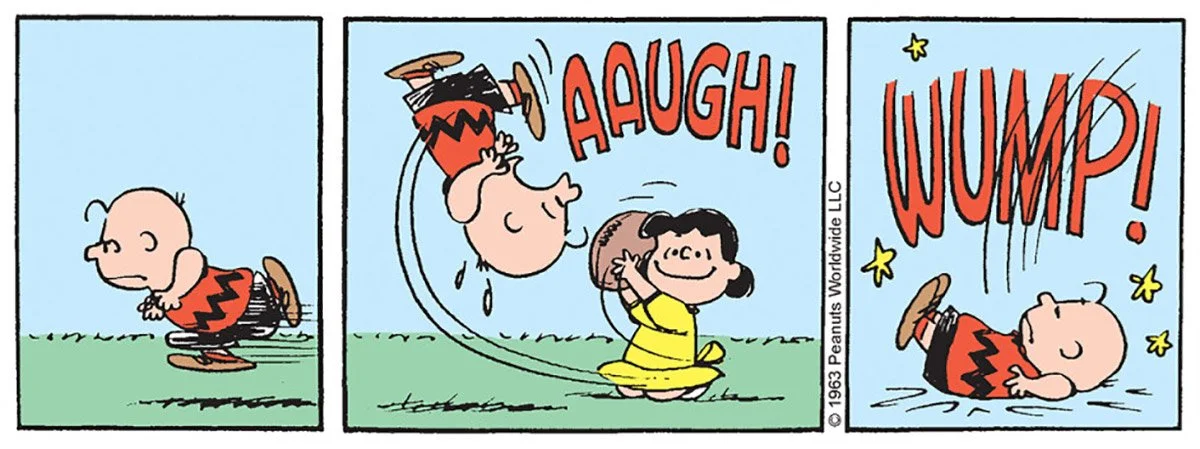
Lucy has been pulling that football for sixty years. Charlie Brown keeps running at it because this time she means it. The MDIC is very good at meaning it—at least until the pricing page goes live.
The information in that LinkedIn post wasn't technically wrong. That's what makes it effective. It's accurate enough to build trust, incomplete enough to make the gap feel solvable, and framed precisely to make a platform look like the solution.
What it doesn't tell you is that the figures cited represent a category of placement that most composers will never see. It doesn't tell you that background cues—the actual volume of sync commerce for most working composers—pay a small fraction of those numbers. It doesn't tell you that the supervisors placing music in major network dramas are not browsing submission platforms. It doesn't tell you that the catalogs landing those placements were built over years, signed by publishers who put real money behind them, and pitched by agents with long-standing relationships on the other side of the deal.
It doesn't tell you any of that because none of that is useful to the malignant business model of the MDIC.
Your music may be excellent. I have no way of knowing while sitting here typing this screed. But if labels haven't signed it, if publishers haven't put their own money and muscle behind it, if sync agents haven't looked at your catalog and decided their reputation was worth staking on a pitch that includes your music—those are data points worth sitting with before you conclude that a submission platform promising “Sync Licensing Jackpot!” is the missing piece of your burgeoning career in music licensing.
The algorithm is not your friend. The relationship is. Algorithms are pushing you ads that promise riches and a career “you’ve always dreamed of,” but algorithms aren’t there to provide you success, they exist to monetize your relative ignorance about an arcane industry while actually selling the dream.
Genuine, meaningful success in this business is built the slow way, in person, over time, through relationships with people who have something to lose if they waste a supervisor's time.
That part of the equation doesn't have a pricing page and definitely doesn’t offer pay-to-play “VIP” access.
Daniel Holter is the founder of The License Lab, a production music library based in Seattle, WA and distributed globally by Universal Production Music. Over a 30-year career, he has sold three catalogs to major publishers (Sony/ATV, Zomba/BMG, and Warner/Chappell) and continues to champion independent, human-crafted music for sync licensing.