The Music Is Not the Work
Finishing The Music Is Where the Work Begins
There's a version of this career that a lot of young composers have in their heads.
Make great music.
Get heard by the right person.
Land a deal.
Build something real.
Profit.
The first step isn't wrong… that’s the barrier to entry. But the rest of the sequence is missing most of what actually happens, especially in the realm of sync licensing and production music catalogs.
I've talked with a lot of composers over the years who couldn't understand why their career wasn't moving. The music was good… genuinely good, sometimes. Ten albums deep or more, consistent output, real craft on the recordings. And still nothing. They'd play me something and watch my face, waiting for the part where I explained what was wrong with the music. That's not usually what I thought to tell them.
What I had to tell them was harder : the music being good is merely the entry requirement, not the achievement. Your grandmother loving it, your partner liking it, your peers nodding along… none of that is the signal you think it is. The business of production music has never had a shortage of good music (let’s ignore the 80s for our purposes here). What it has seemingly always had a shortage of is composers who understand the work that comes after the music.
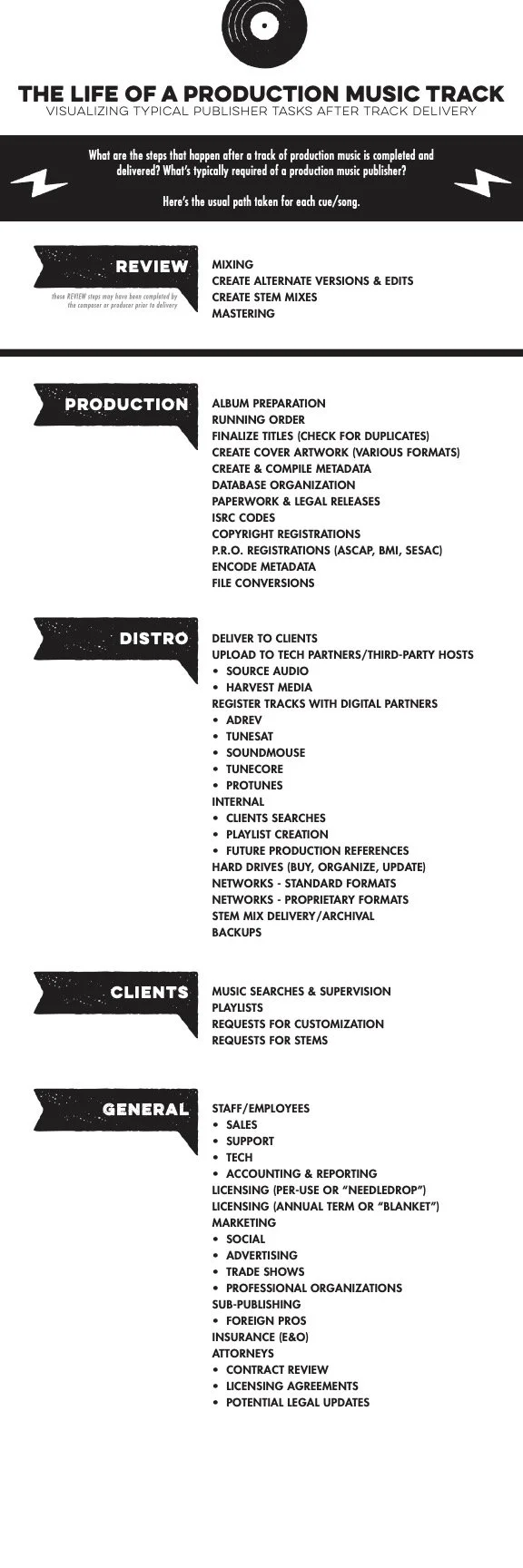
A few years ago, when I was on the Communications Committee for the Production Music Association, we built an infographic that mapped every step that has to happen after a piece of music is delivered and approved… before it ever earns a penny. It’s at least 40 steps (and more have been added in the years since). The response from composers who saw it and responded was nearly a universal “whoa.” Not because the information was all that secret… but because nobody had ever laid it out in front of them all at once.
So what comes after you make the music?
The honest answer is… more than most people want to hear about.
Metadata is the part that makes most young/early composers roll their eyes, and it's the part that costs unsophisticated composers real money for years without them ever knowing why. Every track you release into a library or a platform exists inside a system that can only find it, categorize it, and pitch it if the information attached to it is accurate, complete, and thoughtfully constructed. Wrong tempo? Vague mood tags? Missing instrumentation fields? Misspelled data? A title that tells a music supervisor nothing? These aren't minor oversights, they're the difference between a track that works for you while you sleep and a track that sits in a folder nobody opens. I have seen genuinely excellent music functionally disappear because the metadata was treated as an afterthought.
Reliability is less glamorous than metadata and more important than almost anything else. The production music world is not large. The people who place music, who run libraries, who make decisions about whose catalog they want to invest in… we all talk to each other, we remember, and we usually have long histories with the composers with whom we work. Showing up late, delivering stems that weren't prepped correctly, going quiet when someone needs a revision, treating deadlines as suggestions… all of it accumulates into a reputation that follows you.
Conversely, being the composer who always delivers clean files, on time, without drama is a competitive advantage that compounds quietly over years. It sounds like a low bar. But it isn't, in practice.
The legal side is where I see the most expensive mistakes, and usually the most avoidable ones. Splits that were never documented. Agreements that exist only in email threads. Work-for-hire situations where the composer didn't actually understand what they were signing away. Publishing rights that got tangled up because nobody clarified ownership before the music went out the door. None of this requires a law degree to get right… but it does require treating the business side of what you're doing with the same seriousness and passion you bring to the creative side. Too many composers don't, until something goes wrong. And something always eventually goes wrong when the paperwork isn't clean.
The gap between making good music and building a real return from it is where careers either develop or stall. The composers I've watched build something durable over time are rarely the ones with the most talent in the room. They're the ones who understood early that the creative work and the business work are two halves of the same job… and the ones who got serious about both.
Finishing a record is not the summit. It's the trailhead.